
/image%2F0991366%2F20251019%2Fob_93f265_10000banniere10.jpg)
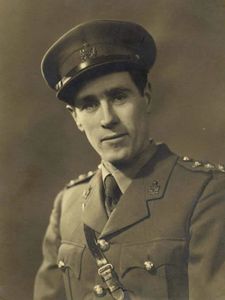
Captain Jerry Roberts MBE (Raymond C. Roberts) (18 November 1920 – 25 March 2014) was a British businessman and wartime codebreaker.
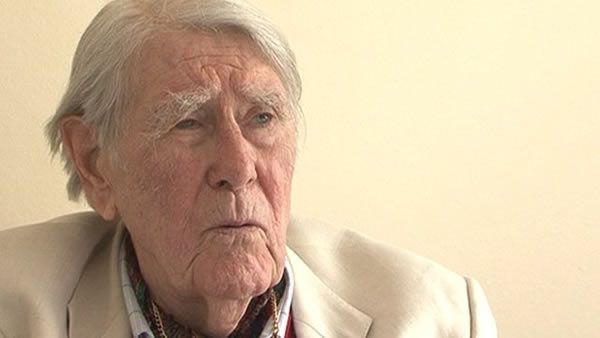
During World War II, Roberts was worked at the Government Code and Cypher School (GC&CS) at Bletchley Park from 1941 to 1945. He was a leading codebreaker and linguist, who worked on Tunny — Hitler's most top-level code. Born in Wembley, London, England, Jerry Roberts' father was a pharmacist and his mother an organist who played in the local chapel. Jerry Roberts was educated at Latymer Upper School, Hammersmith in London 1933-39. He then went on to University College London 1939-41. He gained a degree in German and French.
Early in World War II, his tutor at University College London, Professor Leonard Willoughby, who had worked during the First World War in Room 40 the main cipher-breaking unit of that time, recommended the twenty year old Jerry as a German linguist to the Government Code and Cypher School at Bletchley Park where he was interviewed and accepted by Col. John Tiltman as a codebreaker and linguist. Roberts was one of the four founder members of the Testery in October 1941. After a few months of breaking of a Double Playfair cipher system used by the German Military Police, the team was tasked with breaking the German High Command’s most top-level code Tunny, after Bill Tutte had successfully diagnosed the logic of the Tunny system in Spring 1942.
Captain Roberts was one of the three original senior linguist-cryptanalysts working on the daily breaking of Tunny. The other two were Maj. Denis Oswald and Capt. Peter Ericsson. Ralph Tester was the head of the unit (a linguist but not codebreaker). Roberts was one of the three shift-leaders in the Testery (total staff 118 by 1945), and worked there until 1945 War’s end.
By the end of the War, the Testery had grown to 9 cryptanalysts, a team of 24 ATS, a total staff of 118, organised in three shifts working round the clock. Messages broken by hand amounted to 1.5 million pieces within 1st year of its foundation. After the Testery had been breaking Tunny for a year by hand, the Newmanry became active in July 1943. The Newmanry developed and used machine methods to help speed up one stage — breaking of the chi-wheels but the psi-wheels and motor-wheels were still broken by hand in the Testery. From mid-1943 onwards, the Testery is credited with breaking over 90% of Tunny traffic.
 Tunny was Adolf Hitler’s most secret code system and had 12 wheels against well-known 3 wheel Enigma. Tunny was only declassified in 2002 compared with Enigma in the 1970’s. Tunny carried only the highest grade of intelligence; messages signed only by a handful of top Generals and Fieldmarshals, included Adolf Hitler himself. Used between Army HQ in Berlin and the Generals and Field Marshals in the field. Many were signed by Field Marshals; von Rundstedt, Rommel, Keitel, Jodl etc. – as well as a number of messages signed by the Führer himself.
Tens of thousands of Tunny messages were intercepted by the British and broken at Bletchley Park by Capt. Roberts and his fellow code-breakers in the Testery. These messages contained much vital insight into top-level German thinking and planning. Tunny provided vital information that changed the course of the War in Europe and saved tens of millions of lives at critical junctures — such as the Battle of Kursk in Russia, and D-Day. Gen. Dwight Eisenhower (later the U.S President) said after the War "Bletchley decrypts shortened the War by at least 2 years". Tunny decrypts made major contributions to winning the War. Much of this was down to the work of Bill Tutte and the Testery breaking Tunny messages. Enigma decrypts helped Britain not to lose the War in 1941. Tunny decrypts helped shorten the European War by at least 2 years.
After the War, Roberts was a member of the War Crimes Investigation Unit. Thereafter he pursued a new career in Marketing Research for 50 years, forming his own marketing research companies in the 1970s (one for UK; one for the rest of Europe) until they were sold to GfK NOP (National Opinion Polls) in 1993 and continued working as a consultant to NOP assisting with multi-country studies until he was nearly eighty. He spoke fluent German, French and Spanish and used his skill in languages in his work.
1945–1947 — After the War, Roberts was a member of the War Crimes Investigation Unit. There he employed his fluency in the German and French languages while working in the British Zone, interviewing witness, victims and various war cases, taking legal statements from them for use in court. 1948–1954 — Started in market research in London working for Market Information Services (M.I.S a leading Market Research firm). 1954–1959 — In Caracas, Venezuela, Roberts was invited to set up the first general research company in South America (where he learned fluent Spanish) and developed the company DATOS.
1960 — Roberts spent the year in New York, as a manager representing a major international advertising agency (CPV). 1961–1969 — He returned to London as board director of M.I.S. 1970–1993 — Roberts set up his own companies: Roberts Research Ltd and Euroresearch Ltd, and applied his language skills to pioneering multi-country market research studies across Europe for leading UK and multinational companies. Roberts carried out Market Research for a wide range of leading UK and international clients in the fields of product marketing, public opinion and media research. His clients included British Gas, Reebok trainers, DuPont Teflon, Lycra, American Airlines, Chrysler cars, Holiday Inn hotels, and many others. In 1993, NOP bought both of his companies.
Roberts met Mei 1990 in London and they married soon after. Mei is an artist and book illustrator. Roberts was the last survivor of the nine cryptanalysts who worked on Tunny. For the last six years, he campaigned for proper recognition for Bletchley Park's 4T’s — for his colleagues in the Testery, and especially for its three "Heroes"; Alan Turing who broke the naval Enigma, Bill Tutte who broke the Tunny system to helped shorten the War, and Tommy Flowers who designed and built the Colossus, the world's first electronic, digital, programmable computer — to vastly speed up one stage (chi-wheel) of the breaking of Tunny traffic. However, the majority (the rest of 5 stages) of the work was performed by hand in the Testery by codebreakers and support staff.
Roberts was working in the same office when Bill Tutte broke the Tunny system in early 1942. He and a few other key colleagues also played an important role at Bletchley Park. The country was lucky to have these brilliant men in the right place at the right time. Without these three men and the many other supporting personnel at Bletchley Park, the war could easily have been lost.
Roberts was presented to Queen Elizabeth II in July 2011 at Bletchley Park. In October 2011, Roberts was featured in a BBC Timewatch Special titled Code-Breakers: Bletchley Park's Lost Heroes; first broadcast on BBC Two on 25 October 2011. Jerry Roberts provided valuable background information for this programme and he was pleased to see Bill Tutte and Tommy Flowers get credit. But this recognition comes so late, so many went unrecognised for the reasons of secrecy. Most people that served Testery are now dead, the Tunny story has yet to be fully told. He received an MBE in the 2013 New Years Honours List. He was also honoured with a stamp in April 2013, which is available through Bletchley Park Post Office.


/image%2F0991366%2F20260929%2Fob_d1912a_badinski-curt.jpg)
/image%2F0991366%2F20260929%2Fob_116a08_baade-ernst-guenther.jpg)
/image%2F0991366%2F20260831%2Fob_af49c3_game-philip.jpg)
/image%2F0991366%2F20260828%2Fob_fb6e08_mladic-ratko.jpg)